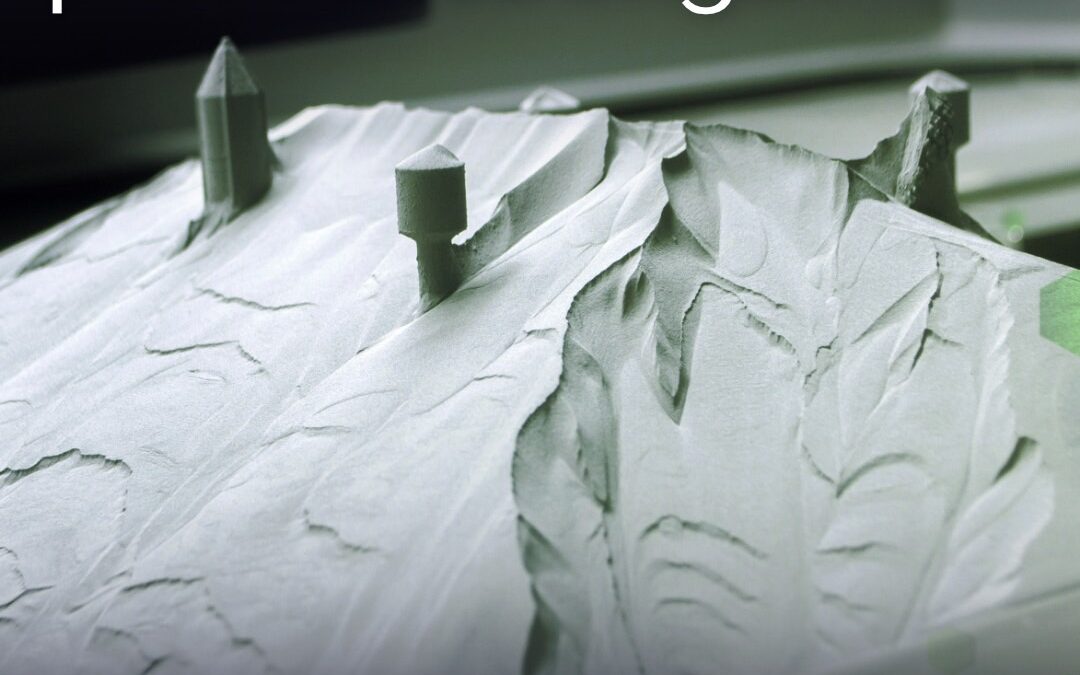
Everyone in binder jetting knows the moment of truth. You lift a freshly printed part from the powder bed and for a moment it looks perfect, until it breaks. A corner snaps or a fine detail gives way under its own weight.
That fragile green part is still one of the biggest barriers to scaling binder jetting for production. If it cannot survive de-powdering, handling and sintering, the entire process slows down. What should be fast and automated becomes careful and unpredictable.
We believe the answer is not stronger hardware or tighter process control. It lies in chemistry.
The Chemistry Behind The Compromise
For years, developers have worked around green strength by accepting a compromise. By making the binder stronger you risk clogging pores which in turn makes de-powdering harder. By making it weaker you risk the part losing its shape.
Every machine operator understands this balance and every materials team has tried to optimise it. Yet the trade-off only exists because most binder systems were never designed for performance; they were designed to make the machine print.
Binder jetting has often been approached as a mechanical challenge, with attention focused on droplet placement, print speed and curing parameters. In reality, the issue runs deeper. It is a chemical interaction that takes place within milliseconds of the droplet meeting the powder bed and that moment determines how the entire process behaves from printing through to sintering.
Chemistry As The Lever
At Atomik AM, we approach green part strength from the inside out. Instead of changing binder quantity or viscosity, we study what happens at the interface, how each droplet interacts with the powder bed and how that reaction shapes the structure of the part.
Our Universal Binder platform was built on this principle. Each formulation is tuned for the surface chemistry of the material it serves, allowing precise control over reaction kinetics, wetting behaviour and bond formation at the micro level. The goal is not adhesion, it is controlled transformation.
When a droplet lands, it does not simply stick. A sequence of controlled reactions begins, forming engineered bridges between particles that give the green body strength while maintaining the open structure required for clean de-powdering. The result is a part that holds together when you need it to and releases cleanly when you do not.
Performance In Practice
The difference is immediate. Green parts printed with Atomik binders can be handled confidently, even in complex geometries. Operators spend less time brushing away powder and more time running the next job, while breakages fall and overall yield improves.
In testing, complex geometries such as thin-walled or deep-channel parts often expose the limits of conventional binder systems. These shapes tend to fracture or resist full de-powdering, slowing production and reducing yield. With a tailored formulation that balances interparticle bonding and open porosity, these same features can be produced cleanly and repeatedly without altering machine parameters or compromising density.
This is what we mean by processable rather than printable. It is not enough for a part to come out of the powder bed intact, it must survive cleaning, handling, sintering and finishing. That is where true performance is proven.
Beyond The Green Part
Improving green part strength transforms more than just the first stage of production. Stronger, more consistent parts make it easier to automate de-powdering, reduce reprint rates and minimise waste. They also enable the use of materials once considered too brittle or reactive for binder jetting.
Most importantly, reliable green parts give engineers confidence. When you can trust the integrity of what you print, you can design with freedom. You can push geometries, scale production and know that what you modelled in CAD will make it through to sintering.
Redefining What Printable Means
In binder jetting, green strength is not simply a material property. It is a reflection of how well the process is working. It shows the chemistry between the binder and the powder, the invisible interface where true innovation happens.
At Atomik AM, we are not trying to make things stick. We are creating reactions that make them strong. When chemistry leads, binder jetting performs the way it should.
To explore how our Universal Binder platform can improve your process strength, get in touch with our team. We work with partners to tailor chemistry that delivers reliable, repeatable performance at production scale.