Additive manufacturing is moving into production environments where materials are assessed on more than performance. As adoption increases, decisions are being shaped by how materials behave beyond the point of printing and how easily they fit within existing industrial constraints.
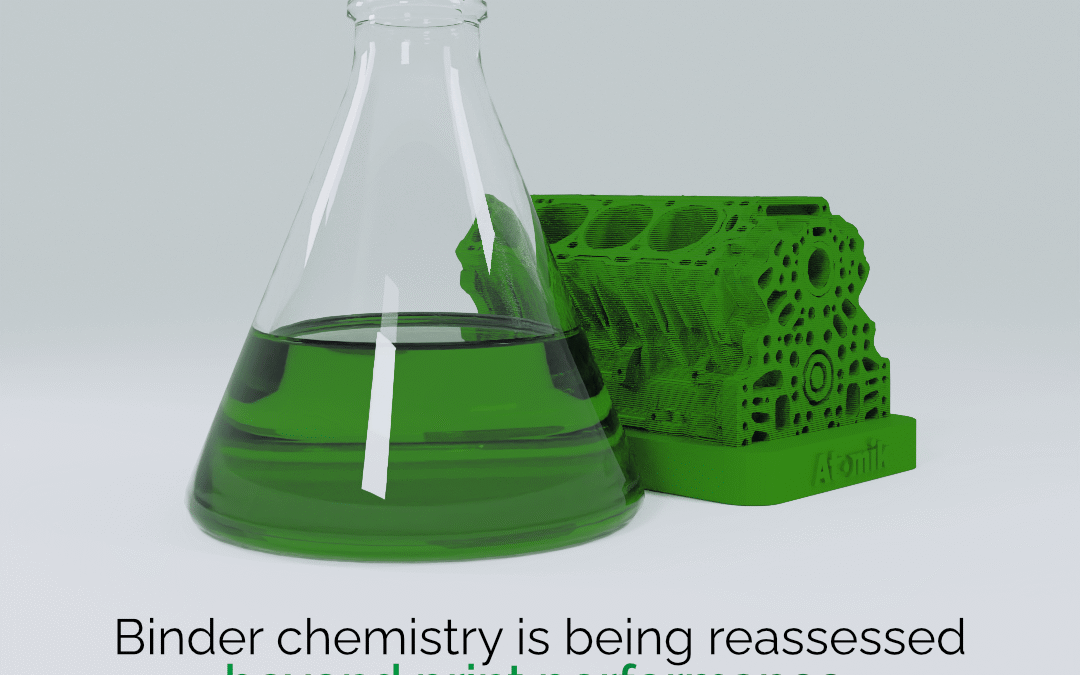
Binder chemistry sits within that shift because it affects both how parts are produced and how materials are managed afterwards. Development has traditionally focused on printability and sintering performance. If a binder enabled stable builds and supported final part properties, it was considered viable. The wider implications of the chemistry, particularly in relation to regulation and what happens to materials after use, have often been secondary.
That position is becoming harder to maintain as regulatory pressure increases and production volumes grow.
Regulation is tightening across regions
Across Europe, chemical frameworks such as REACH are placing greater scrutiny on substances linked to long-term health and environmental risk. Solvents classified as suspected carcinogens or reproductive toxins are being assessed more closely, with restrictions evolving as evidence builds.
Some of these materials are still used within existing binder systems. They remain viable today, although the conditions around their use are changing. Requirements are becoming more restrictive and certain chemistries are coming under increasing pressure.
This is not happening uniformly. In the United States, regulatory movement on some solvent classes has progressed more slowly. The result is a growing gap between what is acceptable in different regions. For companies operating across markets, this creates a constraint that is not purely technical. Formulations need to perform, but they also need to remain usable within multiple regulatory frameworks that are changing at different rates.
Waste handling is becoming more visible
The impact of binder chemistry extends beyond classification and into how materials are managed once printing is complete. Spent powders, contaminated components and cleaning materials all require controlled handling and the route they take depends heavily on the chemistry involved.
In some cases, disposal requires specialist treatment or controlled incineration. These processes introduce cost and add operational overhead that is not always visible at the development stage. At lower volumes, this can be absorbed into the process. At production scale, it becomes more difficult to ignore as material flow increases and waste handling scales with it.
Materials that are difficult to process at end of life place additional pressure on operations and introduce friction into workflows that are otherwise being optimised for repeatability. This is already influencing material development in adjacent areas. In sand binder systems for example, there has been a shift towards chemistries that are easier to manage after use rather than focusing only on performance during printing.
Designing for regulatory alignment
Binder development is starting to reflect these constraints more directly. The focus is moving towards formulations that reduce regulatory pressure while maintaining the performance required for production.
At Atomik AM, binder chemistry is developed with this in mind. Lower toxicity formulations reduce classification burden and make materials easier to manage within production environments. This also affects what happens after printing. Materials that break down in a controlled way are easier to process within existing waste systems and reduce the need for additional treatment steps.
Ongoing testing is building a clearer understanding of how different systems behave across their full lifecycle. This includes how binders decompose, how residues are handled and how materials fit within current and emerging regulatory frameworks.
Scaling will favour compliant systems
As additive manufacturing moves further into production, the requirements placed on materials are changing. Performance remains necessary, but it is no longer sufficient on its own. Materials need to support processes that can scale without introducing additional constraints.
Binder systems that rely on substances already under pressure will face increasing limitations over time. This may take the form of stricter requirements around use or added complexity in how materials are managed after printing. Both introduce friction into processes that are otherwise being optimised for efficiency and consistency.
The industry is already adjusting. Regulation is shaping material selection now and it is influencing how binders are developed for production environments. Chemistry will play a direct role in how easily additive manufacturing can scale without introducing additional operational burden.If this reflects your process or plans for production, get in touch.